Shifting Boundaries – European Photo Exhibition Award 03
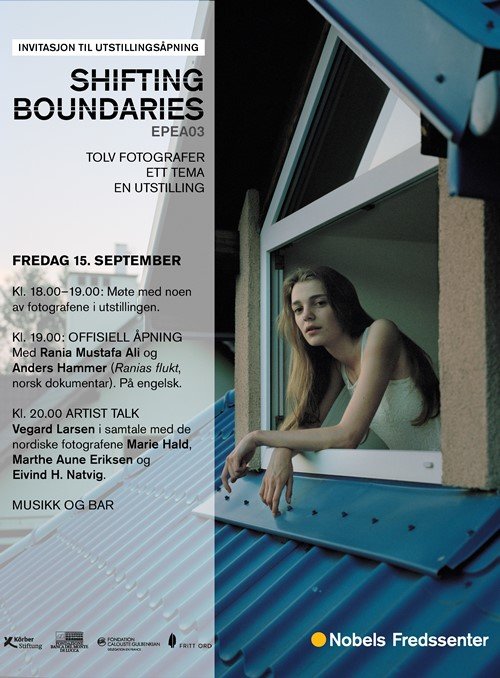
Fritt Ord and the Nobel Peace Centre invite the public to the opening ceremony of “”http://www.facebook.com/events/334798140294553">Shifting Boundaries – European Photo Exhibition Award 03" at 6 p.m. on Friday, 15 September 2017. Twelve young European photographers will show how boundaries are challenged in a Europe in flux.
Young women with eating disorders, soldiers in Ukraine and barbed wire fences in Hungary are among the topics addressed by the photo exhibition, which explores both psychological and physical boundaries. Technological boundaries are also being challenged at a time when the differences between the virtual world and the real world can be hard to see. “Shifting Boundaries” is a visual experience, at the same time as it is a comment on today’s Europe.
The twelve photographers taking part in epea03 are Arianna Arcara (Italy), Pierfrancesco Celada (Italy), Marthe Aune Eriksen (Norway), Jakob Ganslmeier (Germany), Margarida Gouveia (Portugal), Marie Hald (Denmark), Dominic Hawgood (UK), Robin Hinsch (Germany), Ildikó Péter (Hungary), Eivind H. Natvig (Norway), Marie Sommer (France) and Christina Werner (Austria).
Programme
6.00–7.00 p.m.: Meeting with several participating photographers
7.00 p.m.: OFFICIAL OPENING, with Rania Mustafa Ali and Anders Hammer (director and producer), about their work on the Norwegian documentary film “Escape from Syria: Rania’s Odyssey”. The film follows Rania on her escape from Syria to Europe.
8.00 p.m.: ARTIST TALK: Vegard Larsen in conversation with the Nordic photographers Marie Hald, Marthe Aune Eriksen and Eivind H. Natvig
MUSIC AND BAR
The event is open to the public.
The European Photo Exhibition Award (epea) is a European project that aspires to focus on relevant topics by promoting promising young photographers. The project was initiated by the Körber-Stiftung (Germany), Calouste Gulbenkian – Délégation en France (Portugal), Fondazione Banca del Monte di Lucca (Italy) and the Fritt Ord Foundation (Norway).
Exhibition dates
20 May – 28 August 2016: Paris, Fondation Calouste Gulbenkian – Délégation en France
15 October –11 December 2016: Viareggio (Lucca), Fondazione Banca del Monte di Lucca – Villa Argentina
3 March – 1 May 2017: Hamburg, Haus der Photographie der Deictorhallen
15 September 2017 – 28 January 2018: Oslo, The Nobel Peace Centre
Earlier exhibitions in the series European Photo Exhibition Award:
www.epeaphoto.org