Master's grants in spring 2026
What happens to public debate when it takes place outside editor-led media? That’s the question posed by master’s student Emilie Kaland Lindseth. Nora Smevold writes about politics on TikTok, Oda Overvåg about women’s organizations in Tunisia, Alma Owing about student protests, and Eline Ruud Kristiansen about journalism on Venezuela. Read about some of the new master’s grants on freedom of expression, spring 2026.
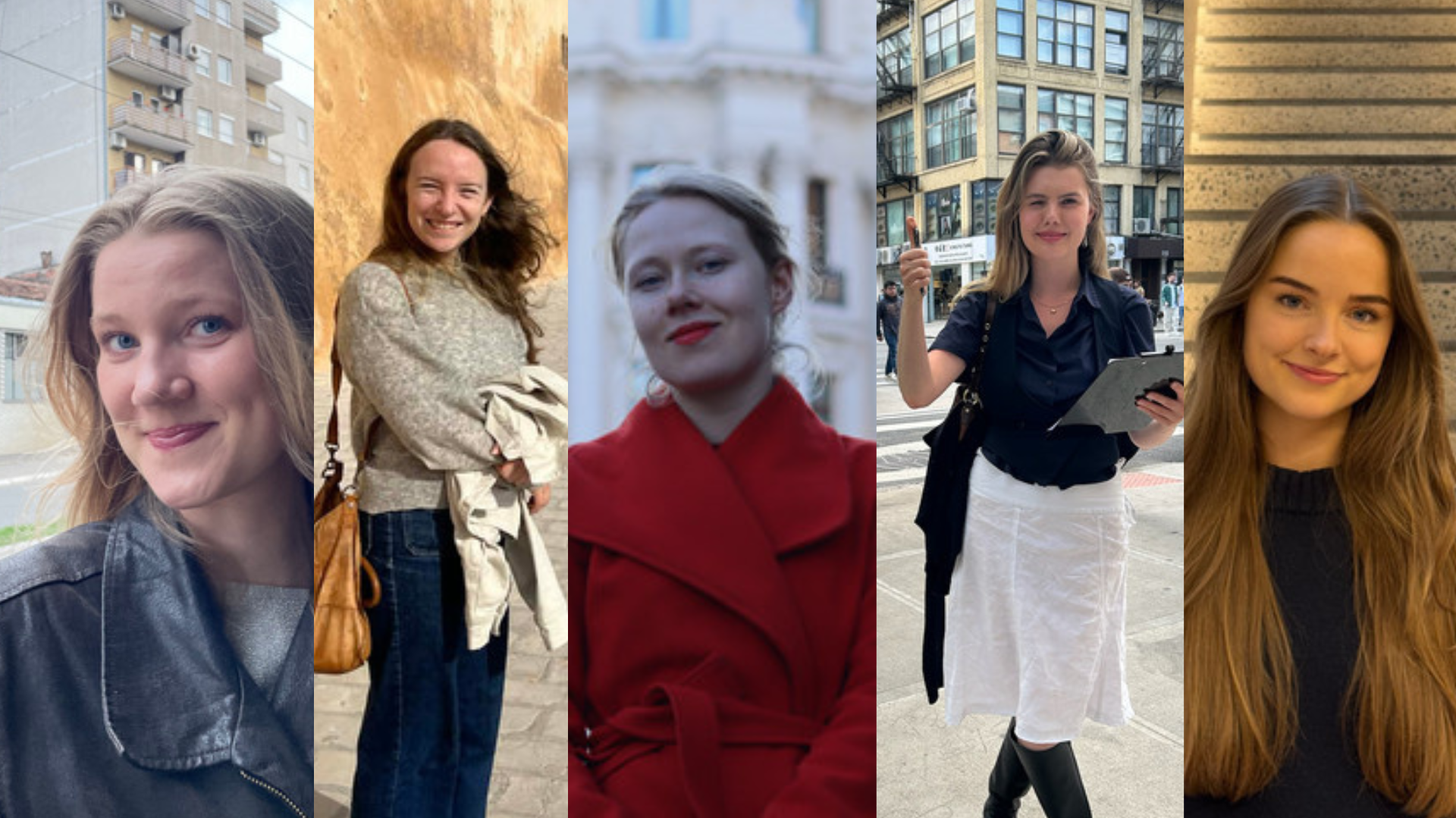
Emilie Kaland Lindseth, Master’s degree in political science, Department of Political Science, University of Oslo
“The research question for my thesis is, so far, ‘What role do online public debaters (in Norwegian: NSD-ere) play in the political discourse?’ The project starts from a media landscape in which trust in editor-led media has fallen markedly over the past decade, while public debate appears to have become more individual-focused,” says the political science student. Lindseth has journalism experience herself, including from Klassekampen, Finansavisen, and Universitas.
“During the 2025 parliamentary election, this development became especially clear, as many voters — particularly young ones — increasingly drew their political information from individuals on social media.
Examples include podcasters like Ole Asbjørn Ness and the collective ‘Gutta,’ whose election-campaign broadcasts reached 1.6 million people. What I argue in my thesis is that these profiles represent a new category of actor in public debate, which I’ve chosen to call ‘online public debaters,’ abbreviated NSD-ere."
“I plan to interview a combination of NSD-ere, editors, and politicians to examine how this newcomer is affecting the relationship between media and politics. Here, the theoretical framework of ‘mediatization’ — the theory of how politics is increasingly adapted to the logic and terms of the media — will be central. I’m also interested in the NSD-ere themselves: who are they, and how do they differ from traditional political actors? To understand them better, I’ll draw on Lazarsfeld and Katz’s 1955 theory of ‘opinion leaders.’ But the overarching theme is still digitalization, and how digital tools have given individuals without editorial grounding a real mediating role in political discourse.
The question I’m asking, then, is: What happens to public debate when it takes place outside editor-led media?"
Nora Smevold, master’s thesis in strategic communication, Department of Communication, Kristiania University College
“I’m going to examine political communication on TikTok.
TikTok differs from traditional channels for political communication and is especially widespread among young people, which makes it a key arena for political actors wanting to reach an audience that’s otherwise hard to reach through other channels," Smevold explains.
The communication student says TikTok’s algorithms present potential challenges for political communication.
“Political messages can get lost in the stream of entertainment content, or it can contribute to increased polarization. How young people themselves perceive, understand, and relate to such content has particular societal relevance, since it offers insight into how political expression is perceived on a platform that was primarily developed for entertainment but increasingly functions as an arena for expression, debate, and political influence,” she explains.
Among other things, she will look at concepts like “politainment” — the blending of politics and entertainment — polarization, and misinformation. The method combines digital diaries and semi-structured in-depth interviews with 10 young voters aged 18–25, who over the course of a week document their exposure to political content on TikTok and reflect in writing on what catches their attention, how content is perceived, and how they understand the messages, she says.
The topic goes straight to freedom-of-expression questions of our time.
Oda Overvåg, master’s thesis in political science, Department of Political Science, University of Oslo
“My thesis is about civil society organizations working on women’s issues in Tunisia. In 2019, Kais Saied was elected president, and since 2021 the country has moved in an increasingly autocratic direction. I want to examine how this political development is affecting women’s rights organizations in the country, and focus in particular on how these organizations respond and adapt to a new political context.
At a time when many countries are experiencing democratic backsliding, and where we’re seeing a global backlash against women’s rights through rising misogyny and populism, it’s important to examine how these two trends affect women’s opportunities to participate in public debate and exercise their freedom of expression," says Overvåg.
The grant will be used, among other things, for fieldwork in Tunisia in 2026, including interviews with experts and civil society organizations and participation in seminars.
Overvåg’s main research question is: How are women’s organizations in Tunisia responding to the process of autocratization?
“My preliminary findings suggest that most of the organizations are largely adapting to the new autocratic regime and trying to navigate within the given constraints in order to survive as organizations. Some women’s rights organizations have thus abandoned the question of democracy in order to keep offering more direct help to women, while others are moving away from political lobbying for women’s rights and toward less politically sensitive topics, such as environmental issues,” explains the political science student.
Alma Owing, master’s degree in Peace and Conflict Studies, Department of Political Science, University of Oslo
“I’m going to look at student protests as a form of collective expression and examine how student mobilization can contribute to democratic processes,” says Owing.
The project analyzes when and how student movements advance democratic demands compared with other social groups, and to what extent such expression is linked to democratization. The study is based on a quantitative comparative analysis of protest data and democracy indicators from 151 countries over the period 1789–2019.
“Student protests demonstrate the fundamental right to express oneself collectively, often through creative and highly visible forms of expression that bring questions of human rights, democracy, and social justice into the broader public debate. By understanding protest as political expression, the project takes seriously students’ role in expression culture, public debate, and as important political counter-voices. At a time marked by democratic backsliding, the study examines whether students still function as a clear democratic voice, and what this might mean for democratic development going forward. Student protests are closely tied to freedom of expression and democratic public debate,” she says.
Eline Ruud Kristiansen, master’s degree in Spanish American Literature, Universidad Complutense de Madrid
“Space for free expression has been significantly narrowed in Venezuela under the Maduro regime, and for many journalists and writers, exile has been the only path to safety. The crónica genre sits at an intriguing intersection between journalism and fiction, where true stories are ‘seasoned’ with literary devices. The texts can be described as both journalistic narratives and narrative journalism,” says Eline Ruud Kristiansen, a Norwegian student in the master’s program in Spanish American Literature at Universidad Complutense de Madrid. This is the only master’s program in Europe offering literature studies focused solely on Latin America.
“Latin America rarely gets much space in the news. That’s why it was especially interesting to follow the polarized debate that arose in Norway after the Nobel Peace Prize was awarded to María Corina Machado and the US arrested Nicolás Maduro,” she says.
In her master’s project, Kristiansen will explore how Venezuelan crónica writers have portrayed the country’s crises over the past thirteen years.
“What happens to the portrayal of the political situation when the line between literature and reality is crossed? How are the concepts of ‘truth’ and ‘objectivity’ problematized? I think these are important questions when we ourselves interpret and debate foreign policy in light of texts — both about Venezuela and other countries.”